Understanding
International Commercial Terms (Incoterms)
Incoterms are internationally recognized trade rules that define the responsibilities of buyers and sellers in global transactions. Navigate international shipping with confidence using these standardized terms accepted by governments and legal authorities worldwide.
Clear Responsibilities
Defines who pays for shipping, insurance, and customs
Risk Transfer
Establishes when risk transfers from seller to buyer
Global Standard
Accepted by governments and legal authorities worldwide
What are Incoterms?
Incoterms are international trade rules that determine who pays for shipping, insurance, and customs, and when risk transfers from seller to buyer. They are widely accepted by governments and legal authorities, helping to facilitate international trade and making them an integral part of global trade contracts.
Standard Framework
Provides a universal framework for international trade contracts, reducing misunderstandings between buyers and sellers across different countries and legal systems.
Cost & Risk Clarity
Clearly defines the division of costs and risks between trading parties, specifying who is responsible for freight, insurance, customs duties, and other charges.
Mode-Specific Rules
Some rules apply to all transport modes, while others are specific to sea freight. Understanding these distinctions is essential to avoid confusion in international transactions.
Incoterms 2020 Categories
Any Mode of Transport
These terms can be used for any shipping method, including air, sea, road, rail, or multimodal transport.
- EXW – Ex Works
- FCA – Free Carrier
- CPT – Carriage Paid To
- CIP – Carriage and Insurance Paid To
- DAP – Delivered at Place
- DPU – Delivered at Place Unloaded
- DDP – Delivered Duty Paid
Sea & Inland Waterway Only
These terms are specifically designed for sea freight and inland waterway transport only.
- FAS – Free Alongside Ship
- FOB – Free on Board
- CFR – Cost and Freight
- CIF – Cost, Insurance and Freight
Incoterms for Any Mode of Transport
These 7 terms can be used for all shipping methods including air, sea, road, rail, or multimodal transport.
Ex Works
Ex works is when the seller places the goods at the disposal of the buyer at the seller’s premises or at another named place (i.e., works, factory, warehouse, etc.).
Key Points:
- The seller does not need to load the goods on any collecting vehicle
- Seller does not need to clear goods for export where such clearance is applicable
- Minimum obligation for the seller
- Buyer bears all costs and risks from seller’s location
Free Carrier
The seller delivers the goods to the carrier or another person nominated by the buyer at the seller’s premises or another named place.
Key Points:
- Parties should specify the delivery point explicitly
- Risk passes to buyer at the specified delivery point
- 2020 Update: Allows for issuance of Bill of Lading with onboard notation
- Suitable for all transport modes
Carriage Paid To
The seller pays for carriage to the named destination, but risk transfers to buyer when goods are handed to the first carrier.
Key Points:
- Seller arranges and pays for main carriage
- Risk transfers at first carrier handover
- Buyer responsible for insurance
- Suitable for multimodal transport
Carriage and Insurance Paid To
The seller has the same responsibilities as CPT, but they also contract for insurance cover against the buyer’s risk of loss of or damage to the goods during the carriage.
Key Points:
- Seller arranges carriage and insurance
- Seller required to obtain minimum insurance cover
- Buyer may arrange additional insurance if needed
- Risk transfers at first carrier handover
Delivered at Place
The seller delivers when the goods are placed at the disposal of the buyer on the arriving means of transport ready for unloading at the named place of destination.
Key Points:
- Seller bears all transport risks to destination
- Goods ready for unloading but not unloaded
- Buyer responsible for import clearance
- Suitable for any transport mode
Delivered at Place Unloaded
DPU is a new Incoterm rule that replaces the former Incoterm DAT (Delivered At Terminal). The seller delivers when goods are unloaded and placed at the disposal of the buyer at a named place of destination.
Key Points:
- Replaces DAT (Delivered at Terminal)
- Seller is responsible for unloading
- Seller bears all risks until goods are unloaded
- Only term requiring seller to unload at destination
Delivered Duty Paid
The seller delivers the goods when placed at the disposal of the buyer, cleared for import on the arriving means of transport ready for unloading at the named place of destination.
Key Points:
- Maximum obligation for the seller
- Seller clears goods for both export and import
- Seller pays all duties and taxes
- Seller bears all costs and risks to final destination
Important Note
These terms are suitable for any mode of transport including containerized cargo, air freight, road transport, and rail shipments. They provide flexibility for modern multimodal logistics operations.
Incoterms for Sea & Inland Waterway Transport
These 4 specialized terms are exclusively designed for sea freight and inland waterway transportation.
The seller delivers when the goods are placed alongside the vessel (e.g., on a quay or a barge) nominated by the buyer at the named port of shipment.
Key Characteristics:
- Risk passes when goods are alongside the ship
- Buyer bears all costs from that moment onwards
- Seller responsible for export clearance
- Commonly used for bulk cargo and non-containerized goods
Seller
- Deliver goods alongside vessel at port
- Export customs clearance
- All costs until goods are alongside ship
Buyer
- Loading costs onto the vessel
- Main carriage (freight)
- Insurance and all subsequent costs
Free on Board
The seller delivers the goods on board the vessel nominated by the buyer at the named port of shipment or procures the goods already so delivered.
Key Characteristics:
- Risk transfers when goods are on board the vessel
- One of the most commonly used Incoterms
- Buyer pays for international transportation and insurance
- Seller covers loading costs onto vessel
Seller
- Deliver goods to port of shipment
- Loading costs onto the vessel
- Export duties, taxes, and customs clearance
Buyer
- Main carriage (freight) from port of loading
- Unloading costs at destination port
- Import duties, taxes, and customs clearance
- Insurance coverage
Cost and Freight
The seller delivers the goods on board the vessel or procures the goods already so delivered. Risk passes when products are on board the vessel.
Key Characteristics:
- Seller pays costs and freight to destination port
- Risk transfers when goods are on board vessel
- Buyer responsible for insurance
- Seller arranges and pays for main carriage
Seller
- Deliver goods on board vessel
- Pay freight costs to destination port
- Export clearance and related costs
Buyer
- Insurance (goods travel at buyer’s risk)
- Unloading at destination port
- Import clearance and duties
Cost, Insurance and Freight
The seller delivers the goods on board the vessel or procures the goods already so delivered. Risk passes when products are on the ship.
Key Characteristics:
- Seller provides minimum insurance cover
- Risk transfers when goods are on board
- Seller pays freight and insurance to the destination
- Buyer may arrange additional insurance if needed
Seller
- Deliver goods on board a vessel
- Pay freight and insurance to the destination port
- Provide minimum insurance cover
- Export clearance
Buyer
- Unloading at destination port
- Import clearance and duties
- Additional insurance (if desired beyond minimum cover)
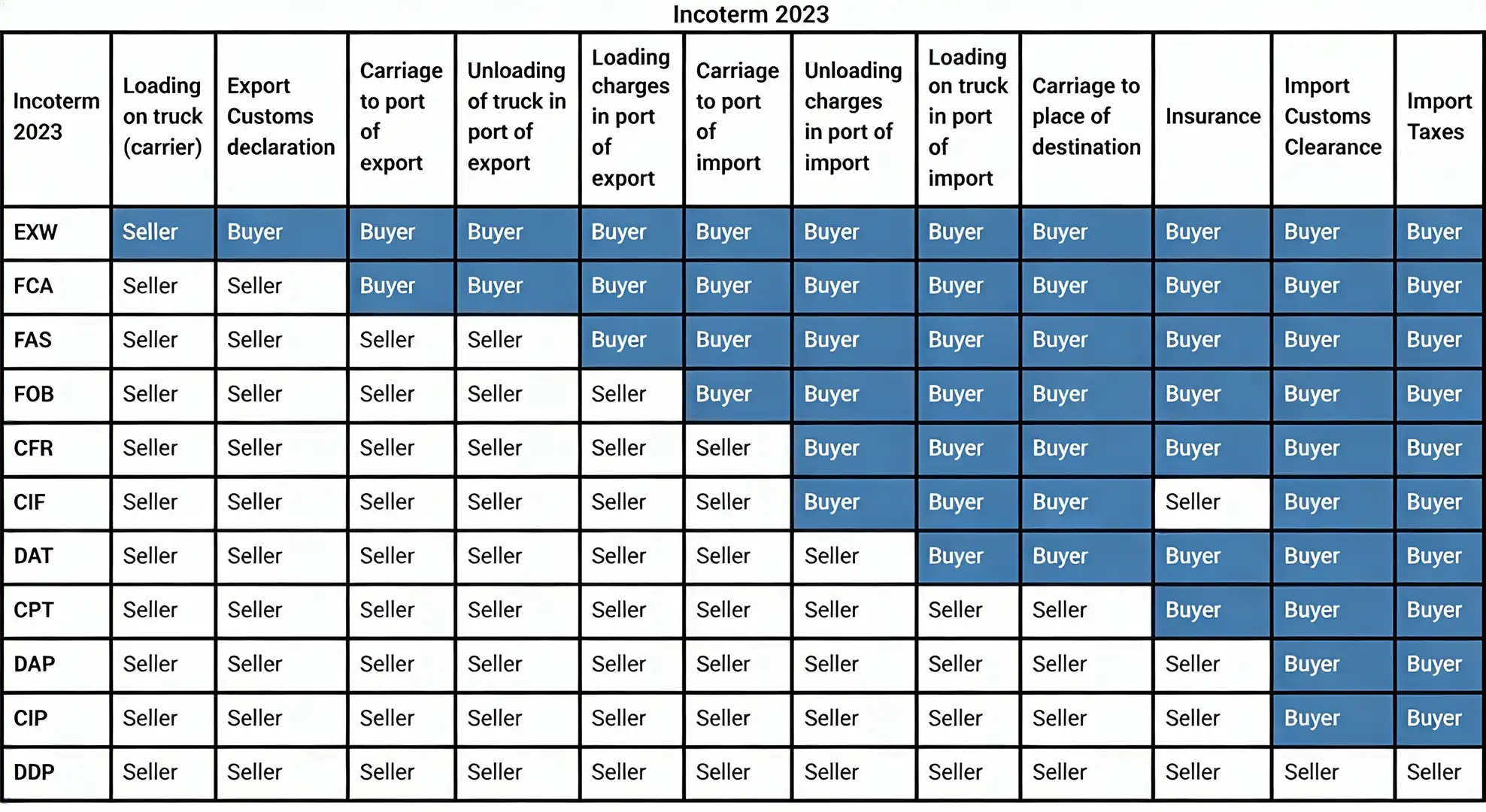
Cost Responsibility Matrix